Pray to the Moon when She is round,
Luck with you will then abound,
What you seek for shall be found
On the sea or solid ground.
Showing posts with label apple. Show all posts

Tuesday, September 25, 2012

For the Files: Autumn Equinox, Community Style

Freyja, by Arthur Rackham
image courtesy Wikimedia Commons
Below is a much abbreviated documentation of our community Autumn Equinox rite. For the files.

Our community Autumn Equinox was celebrated in the Norse tradition of Hausblot, or Fallfest. I attended alone, much to my discomfort, but this particular celebration was not developed/adapted for children & my familiarity with these rites told me that the presence of our children would not be in keeping with the intent of this event. I knew however, despite my conflicting feelings, that of any & all the celebrations hosted by our pan-pagan family, this would be the one which would most speak to me personally.

My pagan roots were set among the Ásatrúar -- their rites are familiar, stirring, honest & potent. It has sometimes mystified me how I never came to embrace Norse Heathenry, but when I examine things fairly, I know that while their values, rites, lifeways & traditions draw me, their cosmology & more importantly, their gods do not. 

The event was planned & coordinated by our community's sole Norse devotee. It began with a blót* in honour of Odin, followed by a wonderful, warm feast. In certain regards, the blót seemed more formal & involved than the blóts-of-yore, but I think some of this is due to selective memory, while some of it is probably because this event was developed for a diverse & public audience. It seems to me my friends-of-yore were much louder too... in fact, I am sure of that, but we were a great deal younger then, a bit more rowdy & much more vociferous. Regardless of how memory matches reality, I must give kudos to Shanley for an artfully developed rite & in particular, for his verse & how he represented our house fires in this ritual. It was very beautiful, symbolically & literally. 

There was some song practice following the feast & we were blessed to have our talented & multilingual songstress sing the verses of Herr Mannelig for us so that we might only struggle with the refrain. I had the luck of being seated beside her & I had one of those moments of utter awe & appreciation for the gifts of our human faculties... the gifts of community too. 

A sumbel* followed feasting & song practice. This was a long rite, lasting nine rounds & two, maybe closer to three hours (not the longest in Heathen history, I am certain!) before we needed to end -- possibly prematurely for some -- due to time & other commitments. There is little I can share about what transpired. All speech in sumbel is sacred speech & it is not my place to repeat it.

I went to this event knowing that I would need to address my outstanding debt to Freyja. I decided to bring some of my apple seeds & restate my oath. I also wanted to read a poem in Her honour -- on behalf of myself & Heather Awen -- so I made certain that this would be in keeping with our host's intentions for the sumbel. It was an honour both to publicly extol Her before my tribe & to represent the voice of someone who has given me a great deal of inspiration. 

I chose a poem written by Hoen Falker of the Visigoth Tradition, Clan Falker & translated by Solange Stanquini. English is obviously not the first language of the author, nor do I believe it is that of the translator, so the poem has some translational idiosyncrasies. However, I found it so beautiful, so moving, that I chose to use it despite a few uncertain lines. I made a handful of small adjustments to assists the flow, but otherwise the poem is as I found it here: Chant to Freyja. My thanks to the author for such a sincere, emotive piece. 

Hail Freyja!


Poem in Honour of Freyja by Hoen Falker

Oh, loved goddess of Elfos, Humans & Valquiras,
that in the starry night,
reigns with replete kindness!
At the thresholds of the world
dressed of hawk
You overstep
giving a present with talents
the treasures where You pass through!
In the shining lands & meadows of the whole people,
celestial fire
it's her glance at rest.
Prostrated, to You I offer
amber & flowers,
tears & laughter.
For my Lady,
the clamours.
Show us,
the human homes in Your mesh.
Mounted on Her high boar,
She helps in the battles.
Your illuminated face in the winds of the heights
for who the fire,
front to the ice,
is like softness.
She is Lady,
of felines & hawks.
My ancestral Ones live close to You.
The half of my songs,
I offer to You.
Oh! Glorious!!
To You I offer
a burning fire of memory.
You are goddess Freyja,
of the Vanires,
the most beautiful woman!
The arches of Your eyes
like wings of swans.
A star.
Your eyes are sunny emerald seas.
Your red mouth is our blood on contemplated snow.
When falls the afternoon,
You become an invisible shine,
for Your destroyed lovers.
To choose,
for You my more beautiful desires,
I will order for the enchantments
intoning rage
& I will see then of the lonely death.
I will wake up.
It will be Your smiling
with all your beloved damsels...
The discovery of your forests
will bring the rain
& to my inert, cold body,
the life will return.


* There are many sources for information regarding the rites & traditions of the Ásatrúar, most of which I am sure are quite excellent. I chose Raven Kindred Online because it actually represents the spirit of my pagan family "of yore." Its authors were among my people & their ways were how I came to understand Ásatrú. You can find the rest of them (almost) at Raven Kindred North.

Tuesday, January 31, 2012

Crafty: Lá Fhéile Bhríde/Imbolc Décor

Yarn & twigs. Stuff to make stuff.


Every so often something happens to me & I make stuff.

This time, it was a request for submissions to our quarterly Pagan community rag up in Alaska. Our fearless leader & editor, the Amazon Druid, asked if we could come up with something clever for the "Family Corner." The result was very clever. I am pretty sure we might have been channeling those clever Nidulariales I wrote about yesterday. This undertaking, which ended up much like an entry at Instructables was so epic, that I am going to post it here if for no other reason than to get a bit more mileage out of it than just the Alaskan newsletter readership. (By the way, if you are interested in receiving a pdf. copy of Roots & Wings via email, contact the editor over at Birch Goddess. You don't have to be Alaskan & I am sure she would be happy to hook you up.)

Before I get to the copy & paste ad nauseam, I must give credit where credit is due. We adapted our design from this Etsy Listing. Alaska is not a place to obtain the traditional materials for this project & the alternatives we found around the internet were, um, tacky. Pipe cleaners? Um, no. So when I came across this gal's design I figured it could be very helpful for Alaskans who won't be finding any straw or rushes out there under the ocean of snow. Of course, if you are not of the mind to make your own, perhaps you would like to purchase one from Nicole, the Etsy shop owner. She is part of Etsy's Team for Animals, "a group of 200 independent artists, independent craftspeople, independent vintage suppliers, and independent art and craft suppliers that combine their efforts to provide charitable relief to animals." Good girl.

Whether you wish to honor Brigid the Saint, or Brighid the goddess (or perhaps you see her as one in the same), this is a very satisfying project. So, without further ado, here is our family's Imbolc Décor "instructable." Please enjoy. (If you make some, feel free to send me some photos, I would love to see your results.)


Making Brigid’s Crosses for Household Protection & Family Fun

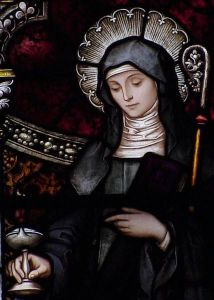
St. Brigid of Kildare @ Wiki.
A Brigid's Cross (called Cros Bríde, Crosóg Bríde or Bogha Bríde, in Irish Gaelic) is a traditional Irish symbol associated with Brigid of Kildare, one of the a patron saints of Ireland. Though it is generally regarded as a Christian symbol, it is likely a pagan remnant. Its design is reminiscent of a sunwheel while Saint Brighid is regarded by many as representative of the ancient Celtic goddess Brighid/Brìde (both pronounced “breed”) or, in more modern parlance, Brigid.

Brighid is said to walk the earth on the eve of her feast. Thus, Brigid’s Crosses were traditionally made from rushes or straw which were gathered on January 31st, the eve of St. Brigit’s Day (Lá Fhéile Bhríde). The crosses were then assembled on 1 February (sometimes February 2nd, or 12th by the old calendar), the day of her honor. 

Brighid by celticseaturtle @ DeviantArt. 
The significance of this for modern Pagans is obvious. St. Brigit’s Day/Lá Fhéile Bhríde occurs simultaneously with the pagan festival, Imbolc/Imbolg (“in the belly”), a traditional agrarian celebration of the pregnancy & lactation of ewes, observed by many modern Pagans, most notably Celtic reconstructionists, Druids and Wiccans. It has been speculated that ancient Imbolc celebrations were also associated with the goddess Brighid. Historical uncertainty aside, Imbolc has most decidedly become Brighid’s feast and it is this we honor.

Brigid Crosses are solar symbols: a woven square with four equal radials extending to the four directions. There are many traditions associated with the making and keeping of the crosses. Most people agree that they act as a talisman for the home, bringing protection to the house and its inhabitants. Many feel they are particularly effective against fire & evil. In Ireland, they are usually hung in the kitchen specifically for their fireproofing prowess. Others prefer to hang them above the inside of the front door or near the hearth. In some traditions, Crosses from the previous year are burned and replaced to affirm the saying: “Out with the old, and in with the new.”

Because traditional materials are unavailable in Alaska during the Imbolc season, we will be working with twigs. We have selected apple twigs since Brigid (allegedly, see interesting debate/discussion here) possessed an apple orchard in the Otherworld, but Birch, Rowan, Alder or other native Alaskan woods will also work nicely. Make sure to trim terminal twigs if possible: they look better and are more pliable. Each cross will require 12 relatively straight cuttings, approximately 4 to 7 inches long. Collect more than you think you will need in case of breakage. Make sure to keep your garden snips handy after you have collected the twigs. They will be needed for trimming at the end of the project.

You will also need scissors & yarn, sisal, raffia, embroidery floss or hemp of your choice to bind the twigs. A needle is very helpful, but not necessary.

  • Assemble your best twigs into four bundles of three & wrap one end with yarn. You can use one color, or many. You might want to use the colors of the Celtic quarters; black, red, yellow, grey, or the colors of the directions according to Ceremonial/Wiccan traditions; green, yellow, red, blue. 


    • Lay out your bundles in the order you will want for the finished design. Cut a very generous length of yarn, twice as long as you think you will need. Fold it in half. If you are using a thick yarn, or multiple colors/strands, you will need extra length. Have your needle nearby if you will be using one. 


      • Take up your first two radials: left vertical and lower horizontal, holding them at right angles with the bottom/horizontal radial overlapping the left/vertical. Pick up your yarn holding the radials with one hand and lace the loop end of your yarn around the center twig near the free end of the horizontal radial bundle. Bring the two ends of the yarn through the loop to create a kind of slipknot. Tighten it down on the center twig and pull the loose strings to the back:


        • If you are using a needle, thread it with your loose ends now.  Begin lacing the yarn through the three twigs in the pattern shown below. We have learned from experience that it is more important to make sure your lacing is tight and symmetrical than in what order you sew the sections. Find the sequence that works best for you and for the material you are using:


          • Add the next radial using the method above, insuring that you create right angles. Check the images to be sure you have it layered properly: each successive radial should overlap the previous. As you move along, you may need to adjust your radial alignment to make sure that your cross will be symmetrical. To do this, simply measure the distance from the angle to the end of the radial. Remember, you will be trimming the unbound ends of the twigs at the end, so make your adjustments by assessing the symmetry of the bound ends. Also, be sure to keep your stitches tight and even, especially as you move from one section to the next.


              • Repeat the process with the last radial, measuring for symmetry and making adjustments. The unbound end of the last radial will need to be place under and at right angles to the left vertical radial. 


              • The last set of stitches should be pulled tight and ended with a knot on the backside. If you have extra yarn length afterwards, you can trim it, or you may choose to use it to hang your Brigid’s Cross.


              • Finally, square your angles, make any final adjustments to your radial alignment and symmetry trim the excess off the unbound ends to complete your Brigid’s Cross. Remember, once the radials are trimmed it will be difficult to make any more adjustments.


              Final Notes:


              The backside will not be perfect and does not need to be. As long as there are no dangling strings or bulging tangles, your cross is fine. 


              Little hands will need some extra help.

              Children can participate in most of this project with proper supervision and a little assistance. Take them on a hike and talk to them about the tress you find. You may want to take this time to talk about Imbolc or the Feast of St. Brigid, what it means to you and how you will celebrate it. When you get home, let them select their own twigs, perhaps even making a counting game out of it. Let them make their own color choices and have them wrap their bundles themselves. If they do not yet know how to tie a knot, this is a great opportunity to learn and practice! Depending on your child and your comfort level, you may want to help them do some of the sewing. Your hands will be of great help to them if they are smaller. The final product is a great prize and will give them a great sense of achievement. You can honor them by using their cross as your house protection talisman, or you might suggest that they deliver it to a friend or family member on Imbolc. This project was a wonderful way for us to spend time together as a family. We hope you will enjoy and share it with your loved ones too!


              Crafty! Brigid's Crosses. A joyful creation.

              Related Posts Plugin for WordPress, Blogger...